Jasmine's pond of dreams

Jasmine's pond of dreams

Thursday, January 17, 2013

The unlucky 7th step of story mapping, Storyteller's Log 1-17-2013

Today, we're approaching the 7th step of our mapping of the character's ups and downs to see our story structure. 

Friendly warning: It's not too late to turn back and stop reading this blog now. 

It is too late for our character. For them, all hope is gone. They've reach the point of no turning back.


In the last blog post, I came across a conundrum. If the things start unraveling in our story, how does that fit with the fact that we're learning about how to weave a story. Which is it? Are we weaving and is unraveling part of that process? 

Yesterday, I was actually puzzled by this and didn't have an answer. That made me tense. I'm supposed to know this stuff. That's why writing this blog has been really helpful to me to evolve this approach to story structure. There is a method to my madness. Usually there always is a method to madness, but it's not always apparent. Extra credit if you can solve this question.

For an excellent book about method underlying "madness" read George Atwood's, The Abyss of Madness. The Abyss of Madness

Our character has alienated his friends, his enemies have gotten the upper hands and they're sinking fast. Have you ever heard the expression, "Everything is going dark?" That's what's happening to our character, they're dying. 

This is known in a lot of screenwriting books as a symbolic death. However, again they don't tell you too much about it. What exactly is a symbolic death? What is it a symbol of?

It can actually take two forms and many films will have both. Often the sidekick can  die, or the main character can feel like their life is over and has no longer has any meaning. They can even feel suicidal like Bill Murry in Groundhog Day.

As a storyteller, I want to know how to make this moment as powerful as possible. I want to know how it feels and how we represent it to make it REAL for our audience.

So, I'm going to leave you with a second pop quiz. If the character dies, is that the end of this blog?
Sadly then, they'll be no extra credit...


Wednesday, January 16, 2013

6th step Empty Success Storyteller's log 1-16-2013

So our character has seen that the goal they've quested so hard after was not what they expected. It was a fool's mission, a get-rich-quick scheme. So they start crashing down, accelerating at the speed of gravity. Things start unraveling.

Things start unraveling? We're learning about story weaving. Is unraveling part of the process?


The Animator's Eye clip available on YouTube
Score by Hans Karl 

What happens on this descent? How do these parts weave in with the rest of the pattern of our story structure? So far we've seen that each piece is logically connected and progressively leads to the next. They're connected in sequences of causality. Cause > effect. In storytelling terms, this is setup and payoff. We set up a cause and later pay if off with the effect of that cause. We may also need to plant extra information so we don't surprise the audience with something out of the blue.

We've set up that the character has ignored the lesson of the story and traveled up the wrong path. In life, whenever we act there are consequences to our actions. We may hurt others feelings or make them mad. Our character probably has done both and now has to face the music. The character might try a last ditch attempt to stop his or her fall but they'll probably use their old defenses and make matters worse, way worse.

The character hasn't learned the lesson, their enemies are stronger and their friends are abandoning them.


Since we're mapping the ups and downs of the character, the audience will follow the character. They will follow the character with one caveat,  they are not the character. They know more than the character. The audience is more like a good friend of the character who knew they were doing things wrong but were helpless to stop them. 

This is our dramatic irony in action. We want to help them because we care about them. Haven't you even seen a horror movie and spoke out loud, "Don't go in the basement?" And what do they do? They go in the basement. But if they didn't go in the basement, would we care about the story?

So, where is all this leading...


Tuesday, January 15, 2013

The 5th step The goal changes Storyteller's Log 1-15-2013

If you know anything about physics or animation timing of a bouncing ball, or if you've ever thrown a ball up into the air you know what happens to it. It comes back down. Our character thinks they've achieved their goal. Let them think that. Let them bask in the glory for a while.

...

Ok, that's enough. But then the story needs to start moving again. A story is like a shark it needs to keep moving or it dies. That sounds familiar, didn't Woody Allen say that in Annie Hall? Oh, he said it about relationships. But it applies equally to stories.

So something has to happen to allow the character to see that what they thought was the goal is actually empty and not fulfilling. It might be an event or another character who shows them where they really are. Remember, they took the wrong path to get there so, of course, they've arrived in the wrong place. Their goal was like a "hot air" balloon and now the air is cooling and they're sinking fast. Hence, the metaphor, "You're full of hot air."

How could they have achieved their goal if they didn't learn the lesson? I told you the lesson would return. This is one of the weaving threads of the story.

So a ball going up will lose energy and come to a stop along the Y axis. Succumbing to gravity it will begin to fall.


A ball going up is a simple case. Characters are more complex. Yes, gravity affects them too, but they'll try and do something about it. Remember those cartoons where the character runs off a cliff. Not until they realize it do they begin to fall. What do they do? They try to fight it by scrambling.

Our character now realizes that what they thought was the goal was actually walking off a cliff. So what do they do? They scramble to try and stop their fall.


Going back to our physics metaphor, when an object falls, it's falls at the speed of gravity.


As we continue to map our character's ups and downs we see they're in trouble now...


Monday, January 14, 2013

Francis Glebas One sheet resume

When I was searching for ideas to make a cool memorable resume, I looked at some online timeline resumes. This lead to the idea of making a movie poster (or one sheet as it's called) for myself. I gathered posters from most of the movies I worked on and composited it together in Comic Life. I used SteelTongs font for the movies poster style text. You can find SteelTongs font for free online.

(CLICK TO ENLARGE)


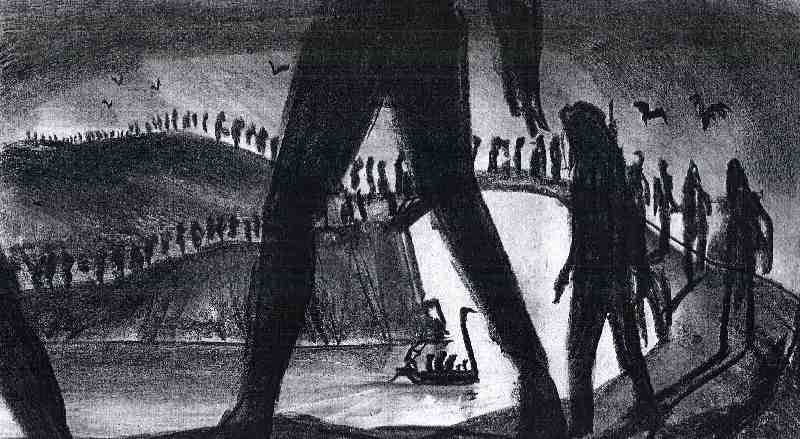
Disney's Hercules Descent to Hades Storyboards

These are storyboards from Disney's Hercules, the descent to Hades sequence. These were completed using watercolor on watercolor paper and charcoal on story pads around 6x9 inches. I loved working with charcoal because you could get such moody effects. The downside was that the mood got all over me and my clothes. It was also hard to correct mistakes or add fine details when using charcoal. It might be cool to start in charcoal, scan it and then work digitally over it.

Below you'll see some full size panels and a complete 4x8 presentation board.

Enjoy. (CLICK TO ENLARGE)


Here are some of the full size samples. As usual for the process, I created several versions of this sequence fine tuning and refining the story. Unfortunately, as beautiful as it was, most of it was passage work and needed to be condensed. Travelogues do not work well in narrative films.


Directors, John Musker and Ron Clements chose James Woods to play Hercules. Before that they auditioned Jack Nicholson for the part. He came in looked at the storyboards and pulled out a lighter to act out the part. It was eerie.


Before the age of digital art, we used to present our storyboards on 4x8 foot cork boards. The story panels were pinned to the boards. I have no idea how many fingers were pierced making all of those animated film. This was yet another version of the sequence.


Sunday, January 13, 2013

Treasure Planet storyboards and visual development

Here's some visual development art from Disney's Treasure Planet. I used acrylic on illustration board. It was fun to explore a science fiction world. We called it visual development. When did it become concept art? So am I a "concept artist?" Darn, I just printed new business cards...

Storyboard panels from the Cosmic Storm when the star goes supernova. I completed over 200 acrylic paintings about 6x9 inches for this sequence. 


Hercules Kidnap Storyboards

Here are some storyboards from Disney's Hercules. In this sequence, Pain and Panic sneak in to kidnap the baby Hercules. Their stealth mission leads to a lot of pain and panic as they sneak in disguised as a Trojan rocking horse baby gift, . This was a fun idea to take something that might be a normal baby gift  and transpose it into the story world of Greek mythology. An innocent rocking horse became a sinister gift concealing dangers. It was also fun to explore the characters letting the rocking horse cause pain when it... (Well, you'll see.) 

I use Comic Life software to assemble the storyboards and add the speech balloons and titles.

Enjoy (CLICK TO ENLARGE)